
adhd treatment for adults
Adult ADHD Treatment for Adults: How to Prepare for an Evaluation in Lafayette

Start with the evaluation decision, not an ADHD label
Adult ADHD treatment for adults should begin with a clinical conversation, not a conclusion you make from a symptom list. Trouble with focus, organization, follow-through, time management, or emotional regulation can affect work and relationships, but those experiences do not establish ADHD by themselves. Adult ADHD can affect education, employment, relationships, and mental and physical health, so the useful first question is how your pattern affects your life and what else may be contributing.
The evaluation decision is practical: decide whether your concerns are persistent enough, disruptive enough, and broad enough to discuss with a qualified healthcare professional. The cited NICE summary says assessment should consider childhood onset, symptoms lasting at least six months, presence in at least two settings, and significant impairment. A cited U.S. review also describes adult ADHD as involving impairment from symptoms in at least two areas of life. These points are questions to organize, not a test you can score at home.
Use this guide to prepare for that conversation in three stages:
- Describe the pattern you notice and the parts of life it affects.
- Reconstruct the history, health context, prescriptions, and goals that may change the discussion.
- Learn the broad treatment categories without choosing a medication or personal plan in advance.
A prepared appointment gives you a clearer way to explain what is happening and gives the clinician information to consider before discussing care.
Check whether the pattern affects more than one part of life
Adult ADHD symptoms matter clinically when they are connected to meaningful impairment rather than occasional distraction or a busy season. The cited U.S. review describes adult ADHD as involving impairment from symptoms in at least two areas of life. Adult ADHD can also affect employment, relationships, education, and mental and physical health, according to the cited adult ADHD review.
Make the impact concrete by mapping your experience across several areas:
- Work: missed deadlines, unfinished projects, avoidable errors, difficulty switching tasks, or trouble sustaining attention in meetings.
- Home: forgotten responsibilities, misplaced items, late payments, unfinished household tasks, or repeated conflict about follow-through.
- Relationships: interrupted conversations, missed commitments, difficulty listening, or problems managing communication.
- Health and routines: inconsistent sleep routines, missed appointments, difficulty following an established plan, or trouble keeping track of prescriptions.
- Emotional experience: frustration, shame, overwhelm, or repeated discouragement after trying to organize the same tasks.
The list is not a diagnostic checklist. It is a way to show what happens, where it happens, and how often it interferes with your responsibilities.
Examples become more useful when they include context and consequence. Instead of writing that you have poor focus, note that you opened a work task three times, shifted to other tasks, and missed a deadline. Instead of writing that you are disorganized, note that you repeatedly lose information needed for a client meeting despite using a calendar. Specific examples help separate a broad label from the pattern you actually want to discuss.
A pattern that appears in only one setting may still deserve attention, but the cited NICE summary says assessment should consider whether symptoms occur in at least two settings and cause significant impairment. Bring both the difficulties and the situations in which you function well. Contrast can be clinically useful too, especially when a demanding work structure hides problems that become more visible at home.
Reconstruct the history a clinician will need
Adult ADHD history includes more than what happened this month. The cited NICE summary says assessment should consider whether core symptoms were present since childhood, lasted at least six months, appeared in at least two settings, and caused significant impairment. Start by looking backward without trying to prove a diagnosis.
Gather memories and records that may describe earlier patterns:
- School comments about attention, incomplete work, daydreaming, impulsivity, or careless mistakes.
- Report cards, evaluations, disciplinary notes, or changes in academic performance.
- Family observations about forgetfulness, activity level, listening, routines, or unfinished tasks.
- Work history that shows repeated difficulty with organization, deadlines, or task transitions.
- The age when the pattern became noticeable and whether it changed as responsibilities increased.
Adult responsibilities can make an old pattern more visible, but a recent increase in difficulty does not by itself establish childhood onset. Tell the full timeline, including periods when structure, support, or a particular job made the problem less noticeable.
Adult ADHD symptoms can be masked by co-occurring psychiatric conditions or adaptations such as occupational choices, according to the cited U.S. review. A demanding professional role may provide calendars, deadlines, and external accountability that conceal the amount of effort required to stay organized. Your history should include both visible outcomes and the systems, stress, and exhaustion behind them.
Build a short timeline before the appointment. Mark when attention or organization problems first appeared, which settings were affected, what supports helped, and what changed before the current concern became urgent. Include major changes in work, sleep, relationships, health, mood, and prescriptions. A timeline is more useful than a general statement that symptoms have always been present because it shows the sequence that needs to be examined. Label each timeline entry as observed, recalled, or uncertain. That distinction is useful when childhood information comes from family memories or old records, and it keeps a missing memory from being treated as evidence that a symptom was absent. Note what support was present when you functioned well, such as external deadlines, calendars, or reminders, and whether the difficulty returned when that support changed. The goal is not to build a case for a label. It is to give the clinician a transparent account of pattern, context, supports, and uncertainty.
Keep reversible and overlapping causes in the conversation
Other explanations belong in an adult ADHD assessment. The cited NICE summary says clinicians should consider learning difficulties, anxiety, depression, trauma, and some medical conditions when evaluating symptoms. This does not mean that your concerns are being dismissed. It means the same attention, energy, memory, or organization problem can sit within more than one health context.
Use a causes-and-context page to ask what deserves review:
- Thyroid disease or thyroid-related findings.
- B12 deficiency, low vitamin D, or another nutrient concern.
- Poor blood sugar control or other metabolic concerns.
- Sleep apnea or a major change in sleep quality.
- Hormone changes.
- Current prescriptions, recent dose changes, or substances that may affect attention, alertness, or sleep.
- Anxiety, depression, trauma, or other mental health concerns.
These prompts are not explanations of your symptoms and are not reasons to order tests on your own. Innovative Medicine states that its advanced testing evaluates thyroid antibodies, free hormones, nutrient status, and key inflammatory and metabolic markers beyond standard panels. Ask what information is appropriate for your situation rather than assuming that every item requires testing.
Current prescriptions deserve a complete review. Bring the name, strength, timing, reason for use, and any recent change for every prescription, over-the-counter product, and supplement you take. Do not stop, restart, or alter a prescription to prepare for an ADHD discussion. Write down concerns and bring them to the prescriber or healthcare professional managing that medication.
A symptom that resembles ADHD may have more than one contributor, and more than one contributor may be present at the same time. The cited NICE summary supports considering alternative explanations before treating the symptom pattern as settled. The practical action is simple: bring the full health context to the appointment, including concerns that seem separate from attention. Reviewing these possibilities can change the next question. If the timing points to a recent change in sleep, health, mood, hormones, blood sugar, or prescription use, record that sequence rather than assuming it proves or rules out ADHD. If a difficulty predates that change, record that as well. The clinician can compare the symptom timeline with the health timeline and decide what needs clarification. This is why a complete context page is more useful than a list of ADHD-like symptoms alone: it shows what began when, what changed, and which questions remain open.
Bring a concise clinical information packet
A clinical information packet gives you a compact record to use during an appointment. It does not need to be polished, and it does not need to prove that you have ADHD. Keep it short enough to review quickly while detailed enough to show the pattern, timeline, health context, and goals.
Prepare these sections:
- Main concerns: list the three or four problems that led you to seek information now.
- Examples: record what happened, where it happened, how often it happens, and what consequence followed.
- Timeline: note childhood clues, adult patterns, periods of improvement, and recent changes.
- Settings: separate work, home, relationships, and other responsibilities.
- Medical history: include diagnoses, past evaluations, sleep concerns, mental health history, and relevant health changes.
- Prescriptions and supplements: include names, strengths, schedules, recent changes, and questions.
- Goals: describe what you hope to improve, such as completing work, managing appointments, listening more consistently, or reducing daily overwhelm.
- Questions: write down what you want explained before the visit ends.
Use the packet to answer the evaluation questions in a clear order. The cited NICE summary says assessment should consider childhood onset, duration, settings, and impairment, so place those details where you can find them quickly. Add examples of strengths and successful supports as well as difficulties. A calendar system, quiet workspace, reminder app, or supportive colleague may reveal which conditions change your performance.
Questions can keep the conversation focused:
- Which parts of my history need more clarification?
- What other explanations should we consider?
- Which records or observations would help complete the assessment?
- What treatment categories might fit the concerns we identify?
- How would follow-up work if a treatment discussion begins?
- What changes or medication concerns should prompt an earlier call?
Bring the packet in the format you will actually use: a one-page summary, a phone note, or a short document with attachments. The immediate purpose is organization, not a predetermined outcome.
Understand treatment as a discussion with several possible components
Adult ADHD treatment can be discussed as a combination of behavioral support, daily routines and lifestyle measures, and medication options. These categories describe the subjects that may come up; they do not tell you which approach is appropriate. The CDC survey reported that 35.2% of adults with ADHD were receiving both medication and counseling or behavioral treatment at the time of the survey, showing why treatment conversations should not be reduced to medication alone.
Behavioral support can focus on the practical demands that interfere with your work and home life. Bring examples of planning, task initiation, time awareness, organization, communication, and follow-through. A discussion may also consider how external structure, reminders, routines, or counseling fit your goals. Ask how progress would be discussed rather than assuming that a particular technique will solve every difficulty.
Lifestyle measures are best treated as supports to discuss, not as a substitute for evaluation. Describe your sleep schedule, work hours, meals, movement, caffeine or other substance use, and the routines that are realistic for your responsibilities. A middle-aged professional in Lafayette may need a plan that fits meetings, commuting, family duties, and changing work demands. Your actual schedule gives the conversation useful boundaries.
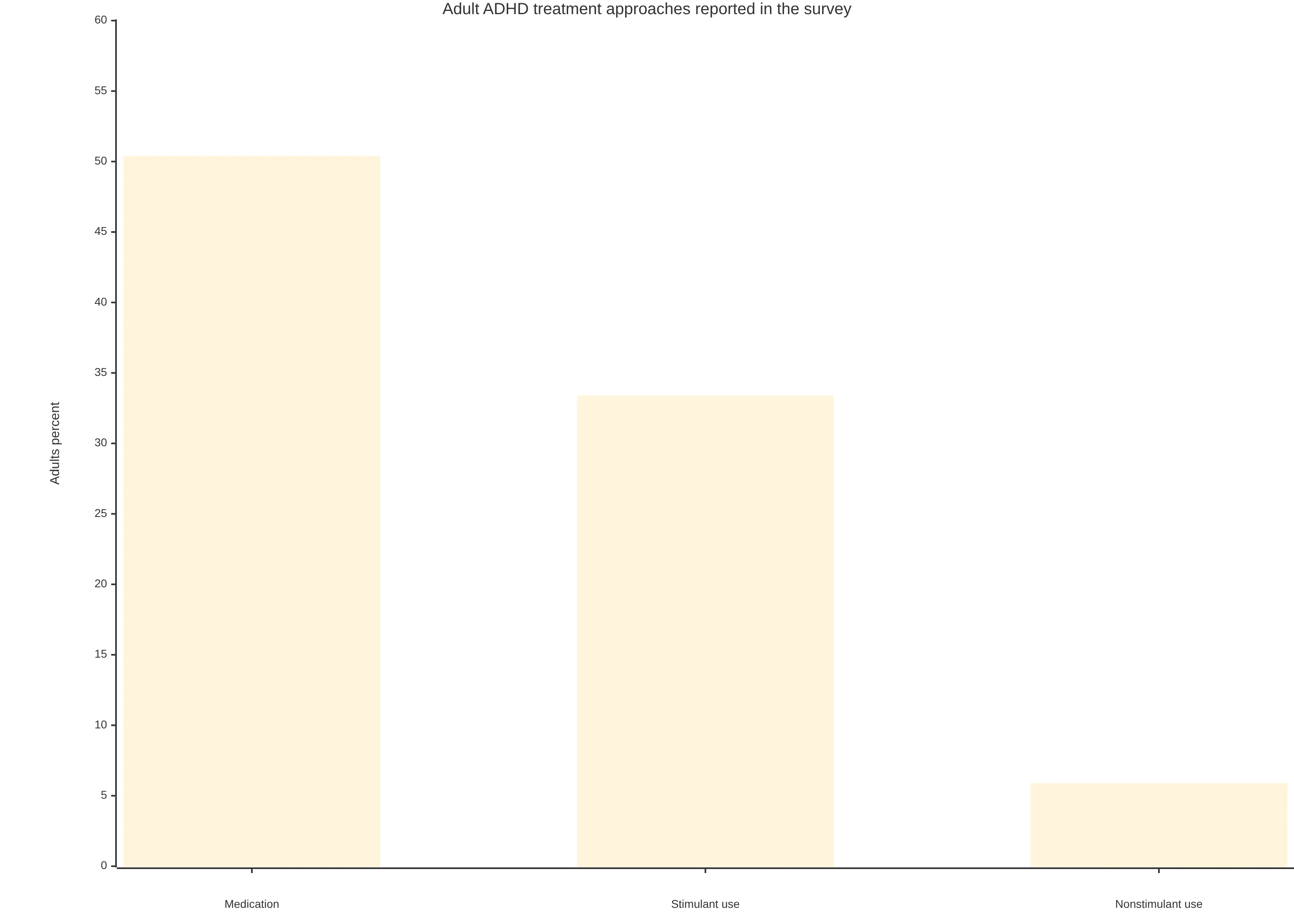
Medication discussions require your full medical and prescription history. The CDC survey reported that 50.4% of adults with ADHD had been prescribed ADHD medication during the previous 12 months, while 33.4% reported prescription stimulant use and 5.9% reported nonstimulant use during that period. Those figures describe survey populations, not a recommendation for you. Do not select a medication, dose, or schedule from a statistic, and do not change an existing prescription without discussing it with the prescriber.
A treatment conversation should connect the approach to the problem you want to address, the health context that has been identified, and the way progress will be followed. The CDC survey included adults receiving both medication and counseling or behavioral treatment, but that finding does not establish that combined treatment is appropriate for every person. Ask what each proposed component is intended to address, what follow-up involves, and what would lead to a change in the plan. One practical way to prepare for that comparison is to describe each concern in terms of the change you want to discuss, the support you already use, and the follow-up you can realistically manage. For example, if missed deadlines are the main concern, note the calendar systems, reminders, or workplace structure already in place and what still breaks down. If attention during meetings is the concern, record the settings in which it is easier or harder to stay engaged. These details do not select a treatment; they help connect the discussion to a specific functional goal.
You can also compare possible components by asking what each one is intended to address, what information the clinician needs before discussing it, how progress would be reviewed, and what would lead to continuing, changing, or reconsidering the approach. Ask how the component fits with current prescriptions, health concerns, work demands, and other responsibilities. If behavioral support or lifestyle measures are discussed, ask how they would be translated into routines you can actually use. If medication is discussed, ask what monitoring and follow-up the clinician expects rather than relying on population percentages or choosing a product independently.
Write the answers beside the goal they relate to. It also leaves room for a clinician to recommend further history, consider another contributor, discuss one component, discuss a combination, or pause before making a treatment decision. The record can separate what you are asking about from what you have already tried, what remains uncertain, and what you want clarified at follow-up.
Use evidence without treating population findings as personal advice
Population findings help you understand treatment patterns, but they cannot determine your care. A CDC survey reported that 55.9% of adults with ADHD received their diagnosis at age 18 or older. The same survey reported that 36.5% were not receiving treatment at the time of the survey and that 35.2% were receiving both medication and counseling or behavioral treatment. These percentages describe the surveyed population at particular time points; they do not predict whether you have ADHD or which treatment you should receive.
A cited U.S. review reported that only 1 in 10 adults with ADHD had received treatment during the previous year. That result and the CDC figures should not be merged into one personal estimate because the measures, time frames, and source populations differ. The useful conclusion is narrower: treatment patterns vary, and a lack of prior care does not settle what your current concerns mean.
A Cochrane comparison of amphetamines with placebo in adults with ADHD reported an anxiety-symptom standardized mean difference of 0.13, with a 95% confidence interval from −0.24 to 0.51. The same comparison reported treatment retention with a risk ratio of 1.06, with a 95% confidence interval from 0.99 to 1.13, based on 2,323 participants. These are study-level results, not a prescription decision or a prediction about your response.
Read medical findings by asking four questions:
- Who was studied?
- What treatment or comparison was tested?
- What outcome was measured?
- What conditions and limitations surrounded the result?
A study result can inform a question without answering it. Bring research questions to an appointment, but keep the decision tied to your history, health context, current prescriptions, goals, and follow-up plan.
Know what this guide cannot decide
This guide cannot diagnose ADHD, confirm childhood onset, determine whether symptoms occur in enough settings, or decide whether another condition better explains your concerns. The cited NICE summary says assessment should consider childhood history, duration, settings, impairment, and other explanations. The cited U.S. review also notes that adult symptoms can be masked by co-occurring psychiatric conditions or adaptations. A symptom list cannot resolve those questions by itself.
This guide cannot choose a medication, dose, supplement, behavioral program, or individualized combination for you. It also cannot tell you to stop an existing prescription or predict how you would respond to a treatment. Those decisions depend on information that belongs in a personal healthcare conversation, including your history, current prescriptions, health conditions, goals, and follow-up needs.
Urgency is another boundary. Seek prompt medical attention for an urgent concern, and keep routine ADHD questions for the planned appointment. Do not use an online checklist to decide that a serious change is only an attention problem.
The useful action is to separate questions you can prepare from decisions that require individualized care. You can document examples, reconstruct the timeline, list prescriptions, identify goals, and write questions. You cannot turn that preparation into a diagnosis or a treatment order. Keeping those roles separate protects the purpose of the appointment.
Separate Innovative Medicine’s care conversation from a guaranteed outcome
At Innovative Medicine, we treat adult ADHD and mental health concerns in Lafayette, Indiana. Contacting us begins a care conversation; it does not guarantee a diagnosis, medication, or treatment plan. Bring the same information you would bring to any serious discussion about suspected adult ADHD: examples, timeline, health history, current prescriptions, and goals.
Innovative Medicine measures patient data and adjusts treatment based on laboratory results and patient improvement. We test patients before treatment and retest them after treatment. These are practice statements about how our care is monitored, not a promise that testing will identify ADHD or that treatment will produce a particular result.
Innovative Medicine states that our advanced testing goes beyond standard panels and evaluates thyroid antibodies, free hormones, nutrient status, and key inflammatory and metabolic markers. That information may be relevant to a broader health conversation, but it should not be treated as an automatic ADHD workup or as a reason to order every test. Ask which information applies to your concerns.
Innovative Medicine collaborates with primary care doctors and specialists rather than replacing them. Tell the practice about existing clinicians, recent evaluations, and current prescriptions so the care conversation has the right context. For questions or appointment inquiries, call Innovative Medicine at (765) 471-1100.
Request a prepared callback in Lafayette
Your next step is to organize a short, honest account of what you notice: where it happens, how long it has been present, what it affects, what changed recently, and what other health or prescription factors belong in the discussion. Add your childhood history, current goals, and questions about behavioral support, lifestyle measures, medication discussions, follow-up, and urgency. A qualified healthcare professional must determine whether evaluation or any treatment is appropriate for you.
Adults in Lafayette who want to discuss suspected ADHD can begin with Innovative Medicine’s adult ADHD and mental health care conversation. Bring your prepared information and describe the outcome you hope to improve without assuming what the evaluation will find.
What should you prepare before asking about adult ADHD care?
What should I bring to an adult ADHD evaluation appointment?
Prepare a concise clinical information packet that includes your main concerns, examples of how symptoms affect your life, a timeline of your experiences, medical history, current prescriptions, and specific goals for treatment.
How can I determine if my symptoms are related to adult ADHD?
Consider whether your symptoms cause significant impairment in multiple areas of life, such as work, home, and relationships. Document specific examples of how these symptoms manifest and affect your daily functioning.
What are the common treatment options for adult ADHD?
Treatment options typically include behavioral support, lifestyle measures, and medication discussions. Each component should be tailored to your specific needs and circumstances.
What factors should I consider when discussing my symptoms with a clinician?
Be prepared to discuss your symptom history, any reversible causes such as sleep apnea or hormonal changes, and how your current medications may impact your attention and organization.
Need help applying this?
Want this looked at properly?
Innovative Medicine is taking new patients in Lafayette, Indiana. Call the office and tell us what has been going on.
Call (765) 471-1100