
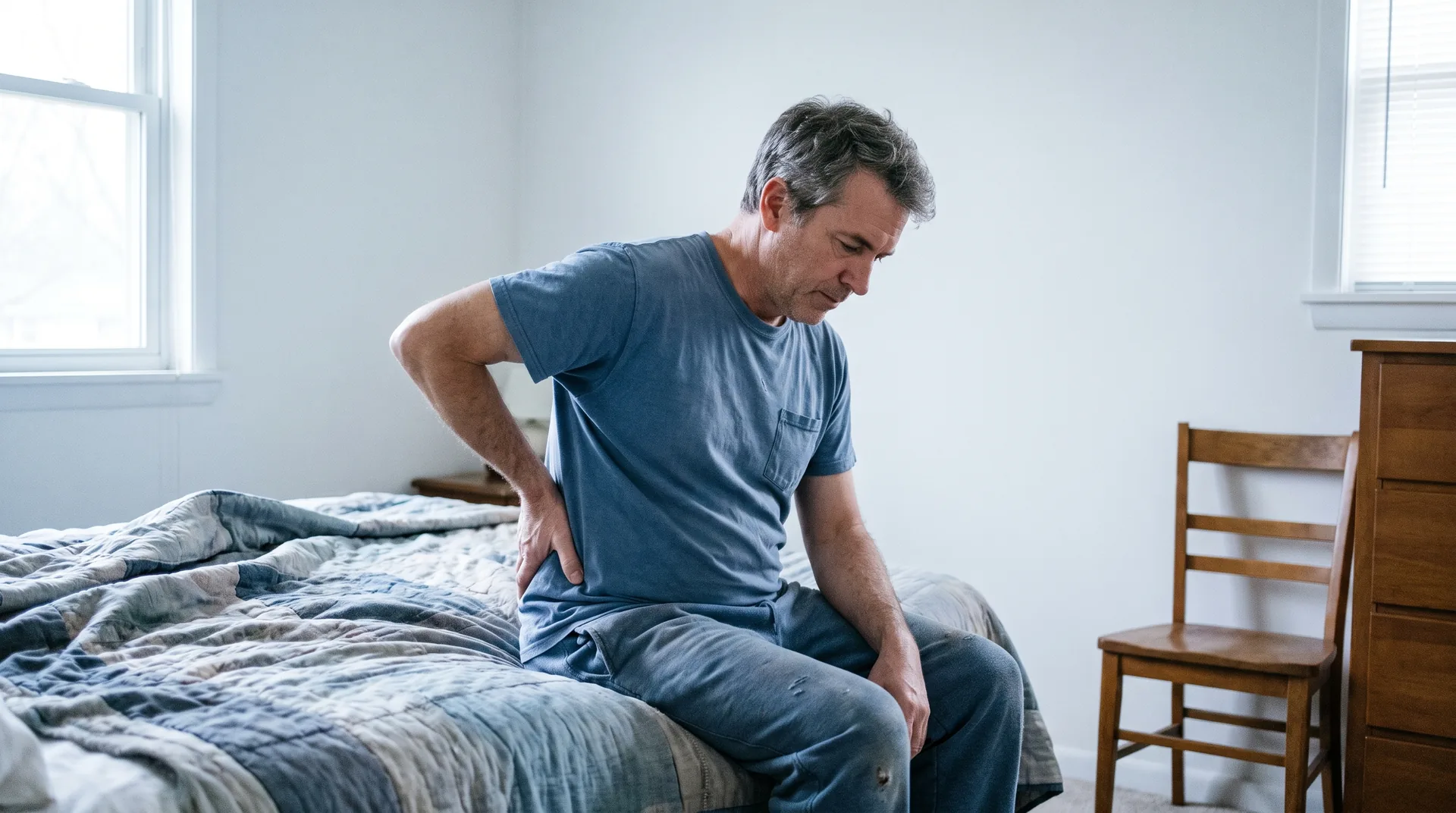
Chronic pain, worked up for its cause

Pain management

Chronic pain, worked up for its cause

Chronic pain evaluated for its hormonal, inflammatory and nutritional drivers in Lafayette, Indiana — alongside conventional pain treatment, not instead of it.

Why the scan came back normal and the pain did not go away

Chronic pain gets treated as a structural problem: image the area, find the damage, treat the damage. When the imaging is unremarkable, the pathway runs out and the patient is left managing symptoms indefinitely.

Pain is produced by a body, not only by a joint. How much of it you feel, and how well you recover, depends on thyroid function, sex hormones, systemic inflammation, sleep and nutrient status — all of which are measurable and none of which show up on an MRI.

This is not an alternative to your orthopaedist or your pain specialist. It is the part of the picture nobody was looking at.

Why it is done this way

Pain that has already been imaged still has a cause worth finding

Most people arriving here have had the scan, taken the anti-inflammatories, and been told to live with it.

Structure is part of the story and often not the whole of it. Thyroid disease, low estrogen or testosterone, systemic inflammation and nutrient deficiency all change how much pain a body produces and how well it repairs.

Those are measurable. Testing for them alongside conventional pain treatment frequently explains why the conventional treatment alone did not work.

What we test

How it works

How care works here

Functional medicine is not a different set of drugs. It is a different order of operations: measure first, then treat what the measurements actually show.

  1. 01

    Step 1

    1. A long first visit

    We take a full history — symptoms, timeline, diet, sleep, stress, medications, family history. Most patients have never been asked these questions in one sitting. This is where the pattern usually shows up.

  2. 02

    Step 2

    2. Testing that goes past the standard panel

    A normal thyroid panel is often just TSH. A normal hormone panel is often nothing at all. We test the full picture — thyroid antibodies, free hormones, nutrient status, inflammatory and metabolic markers — so the treatment plan has something real underneath it.

  3. 03

    Step 3

    3. A plan you understand

    You get your results explained, not filed. What is out of range, what it means, what we are going to do about it, and what should change and by when.

  4. 04

    Step 4

    4. Re-test and adjust

    We re-measure. If the numbers moved and you feel better, we hold. If they did not, we change the plan. Treating on symptoms alone is how people end up on therapy they do not need.

Who this is for

Chronic pain is rarely one problem, which is why one specialty rarely resolves it.
  • Pain has outlasted the injury, or there was never an injury to begin with.
  • Imaging came back unremarkable and nobody offered a next step.
  • The pain arrived alongside perimenopause, menopause or falling testosterone.
  • You have a fibromyalgia label and medication, and neither has helped much.
  • You would rather find out what is driving it than take painkillers indefinitely.

If none of that sounds like you, call anyway — we will tell you honestly whether this is the right service.

Common questions

Can hormones really cause chronic pain?
Yes. Estrogen has a direct role in how pain is modulated, and the decline through perimenopause and menopause is associated with more joint pain, more muscle ache and greater sensitivity to pain generally. Thyroid disease does much the same. Treating those does not always end the pain, but it frequently reduces it — and it is testable.
What does a pain evaluation here involve?
A long history first — where it is, what it feels like, how long it has been there, what makes it better and worse. Then laboratory work: thyroid, sex hormones, inflammatory markers and nutrient status. The plan comes from what that shows.
Do you prescribe pain medication?
Where it is clinically appropriate, yes. The aim is to treat what is driving the pain as well, which is usually what reduces the need for long-term medication.
Do I have to stop seeing my other doctors?
No, and you should not. This runs alongside orthopaedic, rheumatology and pain-specialist care. Where a procedure or imaging is the right answer, we will say so.
Is there a pain management doctor near me in Lafayette?
Innovative Medicine sees patients for chronic pain at 3554 Promenade Pkwy, Suite H in Lafayette, Indiana. Call (765) 471-1100.

Or ask us to call you

The office is open Monday to Thursday. Send this and someone will call you back — a sentence about what is going on is enough.

Please do not send personal health information through this form. We only need enough to call you back.

Find out what is driving it

A first visit covers the history and the laboratory work that conventional pain care does not usually run.