
weight loss diet chart for female
Weight Loss Diet Chart for Professionals: A Flexible Lafayette Meal Framework

Start with a flexible chart, not a rigid prescription
A weight loss diet chart for female professionals works better as a repeatable meal framework than as a fixed menu. Your work schedule, appetite, activity, food preferences, medications, health conditions, and nutritional needs can change what is appropriate, so a general chart should help you make decisions without pretending to prescribe your exact meals. Harvard’s Healthy Eating Plate and Healthy Eating Pyramid are general guides for choosing foods and building meals, while Mayo Clinic recommends realistic goals and small, sustainable dietary changes rather than drastic attempts to lose too much too fast.
A practical chart gives you four things: a structure for each meal, interchangeable food categories, preparation choices that fit your week, and checkpoints for deciding when professional input is needed. Clinical obesity-medicine guidance describes weight management as individualized and beginning with an assessment that can consider nutrition, eating behaviors, physical activity, sleep, social factors, weight history, and related complications. Use the framework below to organize your choices, not to diagnose yourself or select a treatment.
The goal is a sustainable pattern you can use through ordinary Lafayette workdays, busy evenings, and changing responsibilities. Regular physical activity and healthy eating patterns belong in the wider picture of working toward a healthy weight, but this article focuses on meal planning. Start with the chart, notice where your schedule makes it difficult to follow, and treat those obstacles as useful information rather than a reason to adopt a more extreme plan.
Build every meal from complementary food categories
A balanced meal framework begins with complementary food categories rather than a list of approved recipes. Harvard’s meal-planning guidance points you toward general guides for creating healthy meals, and its dietary index assessed patterns involving vegetables, fruit, nuts and seeds, grains, protein foods, fat, sodium, alcohol, and multivitamins. For everyday planning, translate that broad idea into a simple assembly question: what plant foods, protein food, and grain or other satisfying carbohydrate can work together in this meal?
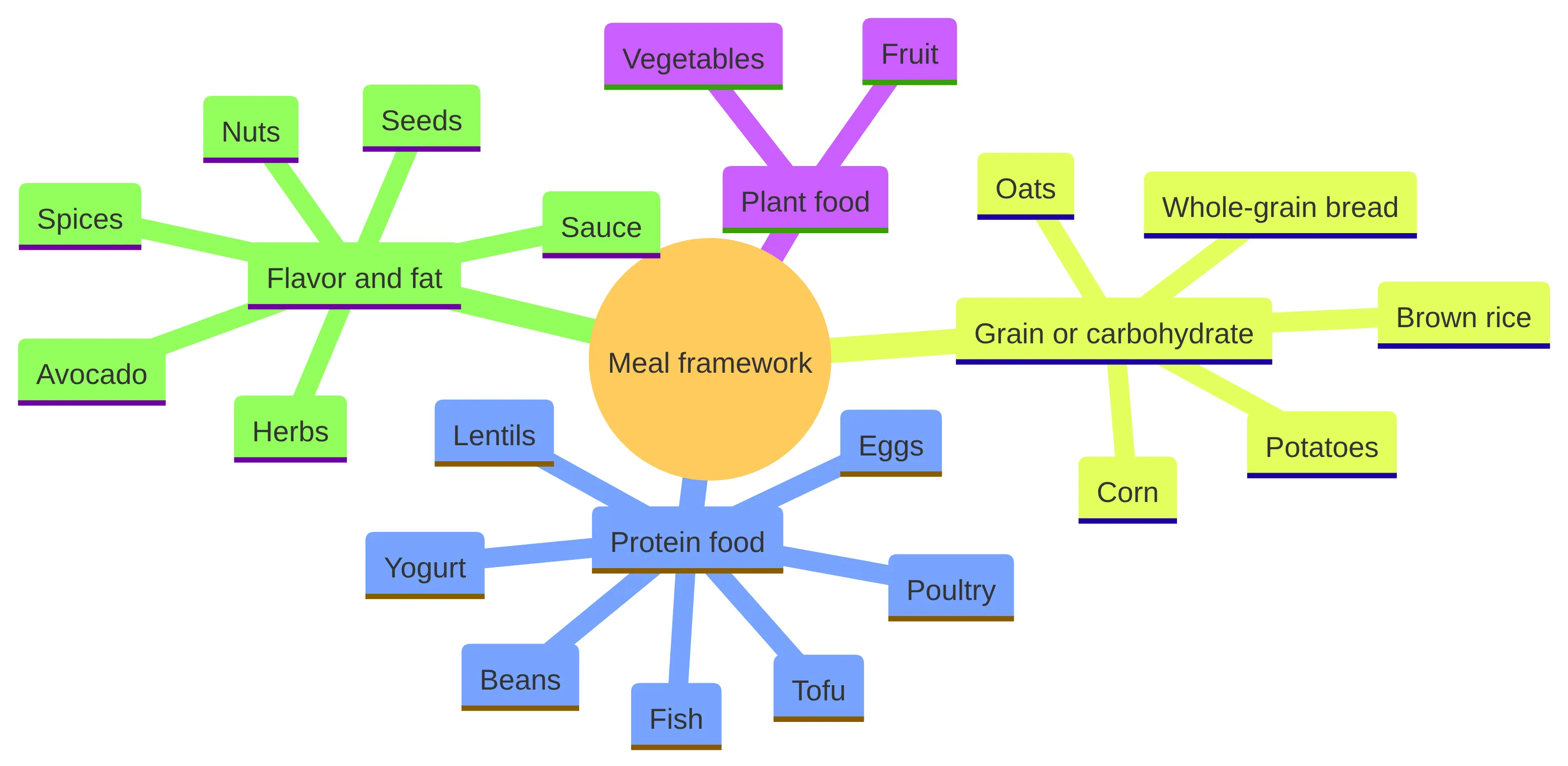
Use this flexible chart when you plan a meal:
- Plant food: Choose vegetables or fruit that you enjoy and can obtain easily. Fresh, frozen, or prepared options can all fit your schedule.
- Protein food: Consider foods such as eggs, beans, lentils, yogurt, poultry, fish, tofu, or another protein choice that suits your preferences and health needs.
- Grain or carbohydrate: Choose an option such as oats, brown rice, whole-grain bread, potatoes, corn, beans, or another food that makes the meal satisfying for you.
- Flavor and fat: Add herbs, spices, a sauce, nuts, seeds, avocado, or another ingredient that makes the meal practical and enjoyable without turning the plan into a rigid rule.
The categories are decision aids, not a requirement to include every item at every sitting or to measure food by a universal portion. If lunch already contains beans and vegetables, you do not need to rebuild it from scratch. If a meal leaves you hungry soon afterward, adjust the combination, preparation, or timing instead of concluding that you need a stricter chart. Keep the categories visible in your kitchen, work bag, or meal-planning notes so you can make a reasonable choice when time is limited.
Meal balance also means matching the framework to the day in front of you. A physically active day, a long stretch of meetings, and a quiet day at home may call for different combinations or timing. Use the categories to build a meal that is satisfying and practical, then make a small adjustment when the pattern is difficult to repeat. That approach keeps the chart useful without turning it into a universal portion prescription.
Breakfast template: make the first meal repeatable
A repeatable breakfast gives you a starting structure before meetings, commuting, or an early Lafayette workday takes over. Build breakfast around a protein food, a fruit or vegetable, and a grain or other satisfying carbohydrate when those categories suit your appetite and nutritional needs. The purpose is not to create a perfect morning meal; it is to reduce the number of decisions you must make before the day begins.
Breakfast options include:
- Plain or lightly sweetened yogurt with berries, oats, and nuts or seeds.
- Eggs with whole-grain toast and fruit.
- Oatmeal with milk or a suitable alternative, fruit, and seeds or nut butter.
- A vegetable-and-egg breakfast wrapped in a whole-grain tortilla.
- Cottage cheese or another suitable protein food with fruit and a slice of whole-grain toast.
These are examples for assembling categories, not a prescribed menu. Substitute foods that fit your preferences, culture, budget, allergies, and medical needs.
Make breakfast easier by choosing two dependable options for the week instead of trying to prepare a different recipe every morning. Keep shelf-stable oats, nuts, or seeds available; wash fruit when you bring it home; and prepare eggs or another breakfast component in advance if that works for you. If you regularly skip breakfast and then eat reactively later, track that pattern for several days and bring it to a clinician rather than forcing a meal schedule that does not fit your body or treatment needs.
A workday breakfast plan needs a backup for the mornings that do not go as expected. Keep one shelf-stable option and one refrigerated option available if those choices suit your needs. When a rushed morning changes what you eat, return to the framework at the next meal instead of trying to compensate with severe restriction. Small, repeatable adjustments are easier to assess than an all-or-nothing response.
Lunch template: assemble a workday meal
A workday lunch should be easy to carry, quick to assemble, and substantial enough to fit the rest of your day. Start with a base of vegetables or fruit, add a protein food, and include a grain or other carbohydrate that works with your appetite and activity. A packed lunch does not need to look like a special diet meal; it needs to be a combination you can repeat when your calendar is full.
Lunch combinations include:
- A grain bowl with leafy vegetables, roasted vegetables, beans or chicken, and a dressing you enjoy.
- A whole-grain sandwich with tuna, chicken, tofu, or beans, plus sliced vegetables and fruit.
- A lentil or bean salad with vegetables, a grain, and a yogurt-based or oil-based dressing that fits your needs.
- Leftover dinner with an added vegetable or fruit so the next day’s meal requires little work.
- A soup containing beans, lentils, poultry, or another protein food, with whole-grain bread and fruit.
Change the ingredients freely. The framework stays useful even when the cuisine, temperature, or available foods changes.
Workday barriers deserve a place in your lunch plan. A short break, shared office food, limited refrigeration, cultural preferences, or a long commute can all affect what you can carry and eat. Pack a lunch that matches the conditions you actually face, and keep a backup such as fruit, nuts, yogurt, whole-grain crackers, or another suitable option if an appointment disrupts your schedule. A plan that acknowledges practical circumstances is more useful than one that assumes uninterrupted time.
An away-from-home lunch can follow the same decision process. Look for a combination that includes a plant food, a protein food, and a grain or other carbohydrate, then choose the simplest available option that fits your needs. If the available meal does not match the framework perfectly, use the next meal to return to your usual pattern. A single disrupted lunch does not require a compensating rule.
Dinner template: use the same structure with more flexibility
Dinner can use the same meal structure while allowing more variation in cooking time, household preferences, and leftovers. Combine a vegetable or fruit, a protein food, and a grain or other carbohydrate, then add flavor in a way that makes the meal satisfying. You do not need a separate dinner menu for every night; rotating a few combinations can protect your evening time and reduce last-minute decisions.
Dinner examples include roasted vegetables with salmon and potatoes; tofu or chicken with vegetables and brown rice; bean chili with a side salad and whole-grain bread; lentil pasta with vegetables; or a sheet-pan meal built around a protein food and vegetables. These examples are interchangeable templates rather than promises about weight change. Choose ingredients and preparation methods that fit your health needs, food access, household, and preferences.
Use flexibility deliberately. If dinner is later than planned, choose a prepared component rather than waiting until you are uncomfortably hungry. If you eat at a restaurant, look for a meal that includes the categories you want and stop treating one meal as a test of whether the entire plan is working. Small changes that you can repeat are more consistent with sustainable planning than drastic rules that make ordinary social or family meals difficult.
Leftovers can serve as both dinner and tomorrow’s lunch. Cook a component that can be combined in more than one way, such as vegetables with a grain and a protein food, then change the flavor or format the next day. This reduces the need to make a fresh decision when your workday ends late. If leftovers repeatedly go unused, prepare smaller amounts or choose components that can be frozen or used in another meal.
Snack template: plan the gap between meals
A snack can bridge a long gap between meals, support a demanding workday, or provide a practical option when your schedule changes. Snack options include fruit with nuts, yogurt with berries, vegetables with hummus, whole-grain crackers with cheese, or a hard-boiled egg with fruit. These are examples, not required combinations.
Use a snack when it solves a real scheduling or appetite problem, not because a chart requires you to eat at a particular time. Keep options at work, in your bag, or in your car only when storage and food safety allow it. If you routinely feel unable to control eating between meals, record when it happens, what preceded it, and whether sleep, stress, medication, or a missed meal may be involved. Bring that pattern to a qualified professional rather than responding with severe restriction.
Choose a snack that you can portion or pack without turning the decision into a daily negotiation. A small set of familiar choices is enough. The chart should make your next action clearer, not create another standard you feel you have failed when your day changes.
Snack timing can be part of your personal pattern rather than a rule you have to follow. Notice whether a snack prevents a long gap, replaces a missed meal, or becomes a response to stress or fatigue. That distinction can help you decide whether to change the food, the timing, the workday setup, or the wider support around eating. Discuss a persistent or distressing pattern with a healthcare professional.
Turn the templates into a busy-professional routine
A busy-professional routine begins with identifying the points where your schedule interrupts eating. Write down your usual breakfast time, work meetings, commute, lunch access, exercise or movement windows, evening responsibilities, and bedtime. Then match the meal templates to those conditions instead of asking your schedule to conform to a perfect menu. Practical, physical-health, psychological, and personal barriers can affect participation and progress in a weight-management plan, so those barriers belong in the design.
The setup process has five parts:
- Choose two breakfasts, two lunches, and three dinners. Keep the combinations familiar enough to prepare without extensive research.
- Identify the hardest meal. Add a backup for the meeting-heavy morning, late commute, or evening when cooking is unlikely.
- Prepare components, not necessarily full meals. Wash produce, cook a grain, prepare a protein food, or portion snacks according to what saves you the most time.
- Create a workday fallback. Keep one suitable option available for a canceled lunch break or unexpected appointment.
- Review the pattern weekly. Change one obstacle at a time rather than replacing the entire plan after a difficult day.
If the routine repeatedly breaks down, ask what condition needs adjustment. You may need different foods, a different preparation method, more realistic timing, support for stress or sleep, or clinical input about a health issue or medication. Mayo Clinic recommends discussing difficult eating or activity goals with healthcare professionals so you can consider new approaches together. A workable plan responds to your life; it does not demand that your life become predictable.
A calendar-based plan can make the framework more concrete. Mark the mornings when breakfast must be portable, the days when lunch needs to be packed, and the evenings when a prepared dinner is more realistic than cooking from scratch. Put the backup food where you will need it rather than relying on memory. If the same barrier appears week after week, record it as a planning problem to solve or a concern to discuss, not as evidence that you need stricter rules.
Use a weekly assembly method instead of a fixed menu
A weekly assembly method gives you structure without locking you into seven identical days. Select a small group from each category, then combine them in different ways. For example, choose several vegetables or fruits, two or three protein foods, two grain or carbohydrate options, and a few flavor ingredients. The exact list can reflect your household, budget, culture, dietary pattern, and access to food.
The weekly assembly method works in four passes:
- First, list the fixed points. Mark workdays, late meetings, travel, social meals, and evenings when cooking is realistic.
- Next, assign templates. Choose a breakfast, lunch, dinner, or snack structure for each type of day rather than naming every recipe.
- Then, prepare the components with the shortest useful shelf life in mind. Use foods that can be eaten early in the week first and keep flexible staples for later meals.
- Finally, leave room for substitution. If a planned food is unavailable, replace it with another item from the same broad category rather than abandoning the meal.
At the end of the week, review what made eating easier and what created friction. Notice whether the issue was preparation time, food availability, appetite, a change in your schedule, or a health concern. Keep the parts that worked and change one part that did not. The point of a weekly method is to make planning repeatable, not to produce a flawless record.
A practical grocery list can follow the same categories: a few vegetables or fruits, several protein foods, one or two grain or carbohydrate choices, and ingredients for flavor. Add portable foods for the hardest workday and components for the meals you already know you can prepare. Keep the list flexible enough to accommodate availability and preferences. If your food access, budget, or medical needs limit the choices, include those realities in the plan rather than treating them as personal failures.
Pair eating changes with sustainable health habits
Eating changes are one part of a wider weight-management approach. The CDC explains that reaching and maintaining a healthy weight involves regular physical activity and healthy eating patterns, while obesity-medicine guidance describes nutrition therapy, physical activity, behavior modification, and medical interventions as parts of a comprehensive approach when appropriate. You do not need to add every possible behavior at once. Choose the next change that fits your current responsibilities and health situation.
A self-review can include:
- What time pressure or emotional situation affects your eating?
- How much movement is realistic with your work and physical abilities?
- Is sleep disrupting appetite, energy, or meal preparation?
- Are cultural, financial, family, or access barriers affecting your choices?
- Could a medication, medical condition, or hormone change affect what you need?
A clinical assessment can consider nutrition, eating behaviors, physical activity, and sleep, along with social and neuropsychological factors and weight-related complications. That broader view can explain why a generic chart may need adjustment.
Favor small changes you can repeat over sudden rules that are difficult to maintain. A useful weekly target might be preparing one additional lunch, adding a planned backup meal, or creating a consistent grocery routine. Your target should describe an action you can take, not a promised rate or amount of weight loss.
Physical activity belongs in the wider plan, but your movement choices should fit your abilities, schedule, and health situation. A short walk between work responsibilities, planned movement at another time, or a conversation about limitations may be more useful than an unrealistic routine. Pair eating changes with an activity approach you can discuss and adjust when needed rather than treating exercise as a penalty for eating.
Know when a general chart is not enough
A general diet chart is not enough when your personal circumstances could change the safety, adequacy, or usefulness of the plan. Weight-management assessment may consider weight history, social and neuropsychiatric factors, possible secondary or genetic causes, sleep, eating behaviors, physical activity, and weight-related metabolic or biomechanical complications. Those questions cannot be answered by a generic menu.
Clinical input is especially appropriate when any of these checkpoints apply:
- You have a medical condition, take medication, or have nutritional needs that could affect meal choices.
- Health, sleep, pain, mobility, hormone changes, or mental-health concerns are affecting eating or activity.
- You have tried to change eating or activity patterns but cannot maintain them, or the effort is causing distress.
- Your personal, cultural, physical-health, neurodevelopmental, or psychological circumstances make participation difficult.
- You are considering medication, a highly restrictive approach, or a plan that promises rapid results.
These checkpoints are reasons to seek individualized guidance, not diagnoses.
Bring a short record of typical meals, schedule barriers, activity, sleep, medications, and questions to that conversation. If a plan becomes difficult to follow, discuss the obstacle and adjust the approach with a healthcare professional. Do not respond to difficulty by cutting out more foods or pursuing a faster result without appropriate guidance.
Prepare for individualized weight-loss guidance
Individualized weight-loss guidance begins with your circumstances rather than with a universal chart. A comprehensive approach starts with assessment and can bring together nutrition, physical activity, behavior change, and medical care when appropriate. Depending on that assessment, a clinician may discuss a long-term plan that includes lifestyle support and, when appropriate, medical or surgical options. The purpose of an appointment is to determine what deserves attention in your situation, not to force you into a preset category.
Preparation for a consultation can include:
- Your usual breakfast, lunch, dinner, snacks, beverages, and weekend pattern.
- Work hours, commute, caregiving, sleep, movement, and the times your plan usually breaks down.
- Weight history and previous approaches, including what was difficult to sustain.
- Current medications, known medical conditions, hormone concerns, and relevant symptoms.
- Your food preferences, cultural practices, budget, access, and goals for daily life.
You can also ask how progress will be assessed, which obstacles matter most, and how the plan would change if your schedule or health changes.
At Innovative Medicine, we offer weight-loss consultation appointments with weight-loss experts in Lafayette, Indiana. We offer weight-loss techniques tailored to individual struggles and goals. Our weight-loss follow-up includes scheduled retesting during the process, and we measure patient data and adjust treatment based on lab results and patient improvement. Those are descriptions of our services, not a determination that any particular approach is suitable for you.
Useful questions can focus on the decision in front of you: Which parts of your current eating pattern deserve attention? How will your work schedule and barriers shape the plan? What information will guide follow-up? Which options, if any, should be discussed after assessment? Bring the meal framework as a starting point, then let the clinical conversation address what a general chart cannot decide.
Discuss a personalized next step with Innovative Medicine in Lafayette
A useful weight-loss chart should leave you with a manageable next meal, a practical backup, and a clear boundary around what general guidance cannot decide. Start with flexible categories, prepare around your Lafayette workweek, and adjust one obstacle at a time. If your health history, medications, symptoms, or repeated difficulty following a plan make a general framework insufficient, discuss your situation with a qualified professional who can decide individual suitability.
At Innovative Medicine, we offer weight-loss consultation appointments with weight-loss experts in Lafayette and provide techniques tailored to individual struggles and goals. A consultation can give you a place to discuss your meal-planning challenges and whether personalized weight-loss care fits your circumstances.
Need help applying this?
Want this looked at properly?
Innovative Medicine is taking new patients in Lafayette, Indiana. Call the office and tell us what has been going on.
Call (765) 471-1100