
how to treat adhd in adults without meds
How to Treat ADHD in Adults Without Meds: A Practical Lafayette Guide

Start with management, not self-diagnosis
Managing possible adult ADHD without medication starts with observing how attention, organization, time, and follow-through affect your actual days. A personal checklist can show you where work breaks down, but it cannot establish that ADHD is the cause. Adult ADHD assessment can include examples of symptoms from the previous six months and questions about inattention and hyperactivity or impulsivity, so your first useful step is to describe a pattern rather than assign yourself a diagnosis.
Non-medication management means building skills and supports around the problems you can identify; it does not mean ignoring persistent impairment or deciding that professional care is unnecessary. Start with a manageable routine:
- Record the situations that cause the most difficulty.
- Choose one organization or time-management support to test.
- Track what happens at work and at home.
- Use the record to decide whether a professional conversation is warranted.
This approach gives you something more useful than a label: a clearer account of what you need help with and how those difficulties affect your responsibilities.
If you work and live in Lafayette, you can use this process while deciding whether to seek an adult ADHD evaluation or a broader care discussion. The goal is not to prove a diagnosis by yourself. The goal is to make your concerns specific enough to discuss clearly, especially when work demands and home responsibilities compete for the same limited attention.
Know where the evidence is strongest
Cognitive behavioral therapy, or CBT, is a supported non-medication approach for adults with ADHD. A systematic review identified 32 eligible studies of non-pharmacological treatment for adults with ADHD; the largest group evaluated CBT delivered in group, internet, or individual formats, and most included studies found improvement in ADHD symptoms with CBT. CBT for adult ADHD can include education about symptoms, organization and planning, time management, problem solving, strategies to reduce distractibility, and cognitive restructuring.
The practical value of CBT is its focus on skills that affect daily functioning. You can translate that focus into a self-management routine by externalizing tasks, planning when work will happen, reducing avoidable distractions, and examining the thoughts or situations that lead to avoidance. The approach addresses occupational and other areas of impairment as well as attention, hyperactivity, and impulsivity symptoms.
You do not need to adopt every technique at once. Match the tool to the breakdown you can describe: use a task list when responsibilities disappear from view, a calendar when timing is the problem, a written first step when starting is difficult, and a distraction rule when interruptions repeatedly take over. This keeps the experiment tied to a concrete function instead of turning non-medication care into a general promise.
The results are not a promise that every strategy will work for you. In a randomized trial of two psychological treatments for predominantly inattentive ADHD, the CADDI group improved activation more than the comparison group, while the between-group effect on procrastination was not significant. That distinction matters: test a method against the problem you want to change, and keep the result specific rather than treating one favorable outcome as proof that every area will improve.
Guidance also differs on how non-medication care fits with medication. The selected UK guideline recommends medication as first-line treatment for adults with ADHD and moderate to severe impairment, while another review states that UK and Australian guidelines recommend CBT alongside medication. You can therefore pursue skills-based support without assuming that it settles every treatment decision.
Build a baseline before changing everything
A baseline gives you a plain record of what is happening before you introduce several new systems at once. Choose a period that reflects normal responsibilities and write down observable events rather than broad judgments such as “my focus was bad.” Useful observations include:
- When you started a planned task and when you actually began.
- Which assignments remained unfinished or required repeated restarting.
- How often you misplaced needed items or forgot a commitment.
- Where interruptions, distractions, or impulsive responses changed the work.
- How transitions between work, home, and personal responsibilities went.
A symptom baseline should describe examples and context. Note the task, the demand it placed on you, what happened, and what consequence followed. Adult ADHD assessment can involve reviewing examples of symptoms over the previous six months, so include longstanding patterns as well as recent changes when you prepare your notes. Do not convert a difficult week into a diagnosis.
A useful baseline has two parts: a small set of repeated observations and a sentence about the cost of the problem. For example, you might record late starts on administrative work, unfinished follow-up messages, and the amount of evening time spent catching up. That record helps you choose one target instead of attempting to repair every part of your routine at once.
Keep the baseline brief enough that you will actually use it. At the end of each workday, answer three questions: what did you intend to do, what happened instead, and which responsibility felt most affected? Add examples from home as well as work when the same pattern appears in both settings. These notes create a timeline you can explain without relying on memory alone.
Externalize the work your mind must hold
Externalizing responsibilities means moving reminders, next actions, and deadlines out of your head and into a system you can see. Organization and planning are established components of CBT for adult ADHD, and CHADD provides adult ADHD time-management materials covering to-do lists and day planners. Your system can be simple; consistency matters more than choosing an elaborate app.
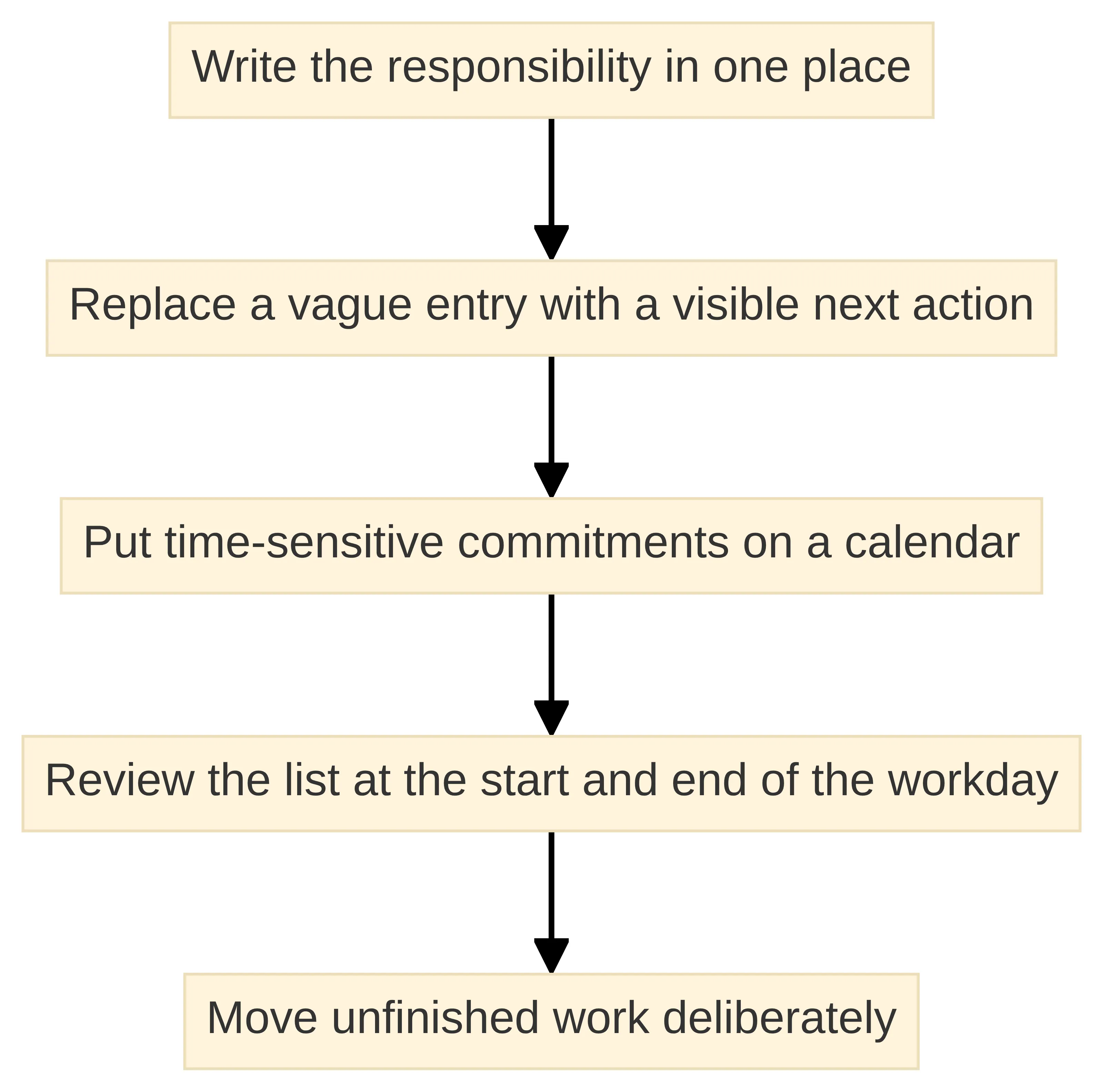
Set up one capture point for new tasks, then turn each task into a visible next action:
- Write the responsibility in one place as soon as it appears.
- Replace a vague entry such as “project” with an action such as “open the draft and list the three missing sections.”
- Put time-sensitive commitments on a calendar and keep ordinary actions on a short list.
- Review the list at the start and end of the workday.
- Move unfinished work deliberately instead of allowing it to disappear among new reminders.
A visible next action reduces the amount of planning required at the moment you begin. Use the same approach for home responsibilities: identify the next physical step, place needed materials where you will encounter them, and assign a realistic time to begin. The purpose is not to create a perfect schedule. The purpose is to make the next decision easier to see.
Keep capture, scheduling, and review separate. A note tells you what exists; a calendar tells you when a commitment must happen; a short list tells you what to do next. When all three jobs are mixed together, a long list can become another source of delay. Give each item one clear home and review that home at a predictable point in your day.
Give time and attention a structure
Time management and reduced distractibility are practical targets within CBT for adult ADHD. Give important work a defined start, a visible endpoint, and a place on your calendar rather than relying on the feeling that you will get to it later. A day planner, task list, calendar block, timer, or written sequence can all serve as external structure.
Build the structure around one work period at a time:
- Pick one clearly defined task before opening email or messaging.
- Remove or silence the interruptions that are not needed for that task.
- Keep the next action visible while you work.
- Stop at the planned review point and record what remains.
- Schedule the next start instead of leaving the unfinished task as a vague obligation.
Shorter work periods may feel easier to begin, while a larger task may need several scheduled starts. Let your baseline determine which problem you are solving: late starts, distraction, losing the thread, or failing to close tasks.
A work-compatible routine also needs transition points. Place a brief planning check before the workday, a reset between major responsibilities, and a closing review before you leave work. These checkpoints do not guarantee better focus; they create repeatable moments to notice what needs attention before the next demand takes over.
Protect the boundary between work and home by giving unfinished tasks a written next step before you stop. That record lets you end one responsibility without carrying every detail into the evening. Use the same approach for personal appointments, household tasks, and follow-up messages: decide what must happen next, where it belongs, and when you will return to it.
Use problem solving when the routine breaks
Problem solving treats a failed routine as information about the system rather than a reason to abandon the whole effort. Problem-solving skills and cognitive restructuring are components of CBT for adult ADHD. When a plan fails, describe the failure in concrete terms: “I opened the task but switched to messages after five minutes” gives you a better starting point than “I cannot focus.”
Use this short review after a missed start, unfinished task, or distracting interruption:
- Name the intended action.
- Identify the point where the plan changed.
- List the immediate barrier, such as an unclear first step, competing message, missing material, or unrealistic time block.
- Change one part of the system.
- Test the revised plan during the next comparable situation.
A single-variable change makes the result easier to interpret. If the task was too broad, define a smaller first action. If interruptions took over, change the notification or workspace rule. If the time block was unrealistic, reschedule the remaining work instead of silently carrying it.
Cognitive restructuring also gives you a way to question automatic conclusions about work. Replace “I always fail at this” with a narrower statement about the event and the next adjustment. The aim is not forced optimism. The aim is a description that leads to a practical action.
Use the barrier to choose the next adjustment:
- If you could not start, make the first action smaller and visible.
- If you lost track of time, place the start and review points outside your memory.
- If messages interrupted you, decide in advance when you will check them.
- If the task kept expanding, define what completion means for this work period.
Test one adjustment in a similar situation and record the result. Keep the adjustment when it addresses the same breakdown; change it when the barrier was different.
Review sleep and other possible contributors
Use a problem-solving sequence for sleep-related difficulties: identify one obstacle, choose one manageable change, and review its effect. Include sleep, mood, stress, pain, substance use, or other health concerns in that comparison without deciding that one factor explains everything.
Professional assessment matters when the pattern is unclear, newly changed, or affecting work and home responsibilities enough that self-management is not answering the question. A UK adult ADHD quality standard was proposed because inconsistent assessments can lead to reassessments and delays in treatment. That finding supports a careful handoff: bring a clear history, examples, and related concerns rather than presenting a single symptom as conclusive.
Keep your notes neutral. Write “I slept differently and missed two morning deadlines” rather than “poor sleep caused my ADHD.” Include when the change began, whether it repeats, and which responsibilities it affects. The record can then help a clinician consider the full situation without requiring you to explain it before you have had an assessment.
Separate a longstanding pattern from a new change in your notes. A concern that has been present across time and settings calls for a different conversation than a recent shift that appeared alongside another health or life change. Bring both patterns to professional assessment, and describe what changed before deciding what it means.
Track function, not just focus
Function gives your routine a more useful target than concentration alone. Track whether you started, completed, remembered, transitioned, and recovered from the tasks that matter in your life. A practical record can include:
- Planned starts compared with actual starts.
- Tasks completed, carried forward, or abandoned.
- Missed deadlines, appointments, or follow-up messages.
- Time lost to interruptions or unplanned task switching.
- Evening catch-up work and its effect on home responsibilities.
- The support you used and the point where it stopped working.
Review the same measures after you have tested one change long enough to observe comparable situations. Compare like with like: administrative work against administrative work, morning transitions against morning transitions, and recurring meetings against recurring meetings. A single productive day does not establish a durable change, and a difficult day does not erase a pattern of useful information.
A function record can support a professional conversation by showing what you experience, how long the pattern has been present, and where the impact appears. Keep the record available in a format you can explain quickly. The point is not to produce a score that decides treatment; the point is to make your examples concrete.
Use a short review at the end of your test period:
- Which function did you intend to change?
- What support did you use?
- In which comparable situations did it help or fail?
- What barrier appeared repeatedly?
- What question remains for a professional conversation?
This keeps the record connected to decisions. It also prevents a vague impression about your week from replacing the specific examples that an assessment can examine.
Understand the limits of non-medication care
Non-medication care can provide skills for planning, organization, time management, problem solving, and reducing distractibility. CBT research also addresses ADHD symptoms and impairment in occupational, social, educational, and other areas. Those findings support a skills-based plan, not a guarantee that every symptom or responsibility will respond in the same way.
These strategies do not establish a diagnosis or determine the cause of attention problems. Do not stop, avoid, or change prescribed medication without guidance from a qualified clinician.
Set expectations around a specific function rather than a sweeping promise. You might test whether a visible next-action list helps you begin administrative work, or whether a scheduled review reduces unfinished follow-up. If the result is mixed, keep the useful part, change the weak part, and bring the pattern to a professional discussion.
Non-medication support can be one part of care rather than a declaration that every other option is unsuitable. The selected Australian guideline notes that non-pharmacological interventions may affect quality of life and other areas of functioning, while those outcomes were rarely examined in the included trials. Judge your routine by the specific function you are tracking, then carry unresolved concerns into a professional discussion.
Recognize when professional assessment matters
Professional assessment matters when you need to know whether ADHD explains a persistent pattern or whether another concern should also be considered. Arrange an assessment conversation when attention or organization problems repeatedly affect work, home responsibilities, relationships, or your ability to manage ordinary commitments; when the pattern has changed and you cannot explain the change; when your self-management record leaves important questions unanswered; or when a safety concern related to attention, impulsivity, or functioning calls for prompt professional support.
Adult ADHD assessment can include reviewing examples of symptoms over the previous six months and assessing inattention and hyperactivity or impulsivity symptoms. Bring examples from more than one setting when they are available, explain which difficulties are longstanding, and identify what has changed. Avoid presenting a single online checklist, one poor workday, or one successful routine as the whole picture.
You can make the conversation clearer by bringing your timeline, examples, functional effects, relevant changes, and the questions you want answered.
Useful questions for an assessment conversation include:
- What information is needed to understand the pattern across time and settings?
- Which work and home examples should you bring?
- What other changes or health concerns belong in the discussion?
- What will happen if the assessment does not support an ADHD explanation?
- How will skills-based support fit with care from other clinicians?
These questions keep the conversation focused on understanding the problem and choosing an appropriate next step.
Prepare a Lafayette conversation
A Lafayette conversation becomes more useful when you bring a concise record instead of trying to remember every example in the moment. Prepare answers to these questions:
- Which attention, organization, or impulse-control problems interfere most with work or home life?
- How long have you noticed the pattern, and what examples show that timeline?
- Which situations make the difficulty more visible?
- What self-management supports have you tried, and what happened?
- Which changes in sleep, mood, stress, pain, substance use, or other health concerns should be included?
- What would you like the evaluation or care discussion to clarify?
We offer functional and integrative medicine services in Lafayette. We collaborate with primary care doctors and specialists rather than replacing them. That makes care coordination a question to raise directly, not a reason to assume that an appointment will provide an ADHD diagnosis or a particular treatment.
Bring your baseline and tracking notes to the conversation, then ask how they fit with the broader evaluation process and with care from other clinicians. A focused record helps you explain the practical problem, while coordinated discussion keeps the next decision connected to the care you already receive.
Before you make contact, put your main concern into one sentence: describe the function that is suffering, the pattern you have observed, and the kind of support you want to discuss. You can then bring the longer record if it is useful. This gives a Lafayette conversation a clear starting point without assuming what the evaluation will show.
Use coordinated support as the next step
A workable non-medication plan starts with a baseline, moves responsibilities into visible systems, gives time and attention a structure, reviews where the routine breaks, and tracks function over time. Use those notes to decide whether self-management is answering the practical problem or whether you need a fuller professional assessment. A qualified professional should decide individual suitability, diagnosis, and treatment choices.
We offer functional and integrative medicine services, and we collaborate with primary care doctors and specialists rather than replacing them. If you are an adult in Lafayette seeking a coordinated conversation about attention and executive-function concerns, bring the record you built and describe the support you are trying to find.
What should you clarify before seeking adult ADHD support?
What are some non-medication strategies for managing adult ADHD symptoms?
Non-medication strategies include cognitive behavioral therapy (CBT), which focuses on skills for organization, time management, and problem-solving. Other approaches may involve creating structured routines, using task lists, and tracking symptoms to identify patterns.
How can I track my ADHD symptoms effectively?
To track ADHD symptoms, maintain a record of observable events such as when tasks are started and completed, missed deadlines, and instances of distraction. This helps identify patterns and informs discussions with healthcare professionals.
When should I consider seeking professional assessment for ADHD?
Consider seeking professional assessment if attention or organization problems consistently affect your work or home responsibilities, if there are significant changes in your pattern of behavior, or if self-management strategies are not effective.
What role does cognitive behavioral therapy (CBT) play in managing adult ADHD?
CBT is a well-supported non-medication approach that helps adults with ADHD develop skills for managing symptoms.
How can I prepare for a conversation about ADHD with a healthcare provider in Lafayette?
Prepare by bringing a concise record of your symptoms, examples of how they affect your daily life, and any self-management strategies you’ve tried. This will help facilitate a focused discussion about your concerns and potential next steps.
What should I avoid when managing ADHD symptoms without medication?
Avoid self-diagnosing ADHD or assuming that non-medication strategies can replace professional evaluation and treatment. It’s important not to stop or change prescribed medication without consulting a qualified clinician.
Need help applying this?
Want this looked at properly?
Innovative Medicine is taking new patients in Lafayette, Indiana. Call the office and tell us what has been going on.
Call (765) 471-1100