
loss weight programs
How to Compare Weight Loss Programs for Your Goals and Work Life

Begin with the program-fit question
Choosing a weight management program starts with fit, not with a promised result. Before you compare providers or formats, identify the health concerns you want addressed and the goals you want the program to support. Those goals might involve changes in weight, daily energy, movement, confidence, or the ability to maintain a routine around demanding work. Clear goals give you something concrete to discuss rather than leaving the decision to a slogan or a single feature.
Your health context also changes the questions worth asking. A history of medical conditions, previous attempts, current medicines, or other treatment may affect what kind of oversight and follow-up you need. You do not need to determine your own eligibility before speaking with a professional. You do need an accurate starting point.
Your working life is part of program fit. A plan that requires appointments at times you cannot reliably attend may be difficult to continue, even if its clinical structure sounds suitable. A plan with very little contact may be convenient but leave you without a clear way to discuss changes, questions, or setbacks. Treat schedule, travel, communication, cost questions, and follow-up as decision criteria rather than afterthoughts.
A useful first pass is to write down three things:
- The change you want to work toward and why it matters now.
- The health information, previous efforts, medicines, or concerns a provider should understand.
- The kind of support you can realistically use during a normal workweek.
That short record helps you compare what each program actually provides. It also keeps the conversation focused on your circumstances rather than on a general promise.
A practical comparison asks six questions: Who provides oversight? How is the plan personalized? What gets monitored? What accountability is available? How accessible is the care? What support continues as your circumstances change? These questions do not rank every program in advance. They help you see where two programs differ and which difference matters to you.
The right next step may be a self-directed approach, a digital format, a behavior-focused program, or medically supported care. Those categories can overlap. Start by identifying the level of structure you can use consistently, then examine the safeguards and follow-up attached to it.
What a weight loss program can contain
A weight loss program can contain more than a food list or an exercise target. Evidence-based obesity care may use personalized strategies, explain behavioral and physiological factors, and involve professional collaboration to educate, treat, and monitor patients. A consultation may also address whether nutrition counseling, exercise support, treatment options, or continued monitoring belong in the plan. The exact combination depends on the program and your clinical circumstances.
A useful program description should make its moving parts visible. Look for an explanation of the initial evaluation, the goals being discussed, the support available between visits, the information that will be monitored, and the circumstances that would lead to an adjustment. If the description only emphasizes an outcome, ask what process is supposed to support you along the way.
Structured and self-directed approaches differ mainly in where organization and accountability sit. In a self-directed approach, you usually arrange your own information, routines, tracking, and decisions. In a structured approach, some of those tasks may be built into scheduled care, digital tools, coaching, professional review, or follow-up. Neither label tells you enough by itself; ask what support is actually included.
Self-monitoring is one example of a feature that can appear in several formats. It may involve recording dietary behavior, physical behavior, or weight through a paper system, website, or mobile application. The presence of tracking does not tell you how often someone reviews it or what happens after a pattern changes. Ask who sees the information, how it informs the discussion, and whether the program gives you a way to respond.
Monitoring and accountability are separate program elements. Monitoring means collecting information that can be discussed or used in care; accountability means having an agreed way to revisit progress and next steps. Innovative Medicine states that it measures patient data and adjusts treatment based on laboratory results and patient improvement. Innovative Medicine also describes reviewing progress, adjusting plans as the body changes, and providing accountability between visits. These are specific features of this practice, not a universal description of every program.
A program that includes those elements should still explain what they mean in practice. Ask what information is collected, how often it is reviewed, who discusses it with you, and what happens if your plan stops fitting your schedule or health context.
Compare four program structures by the support they provide
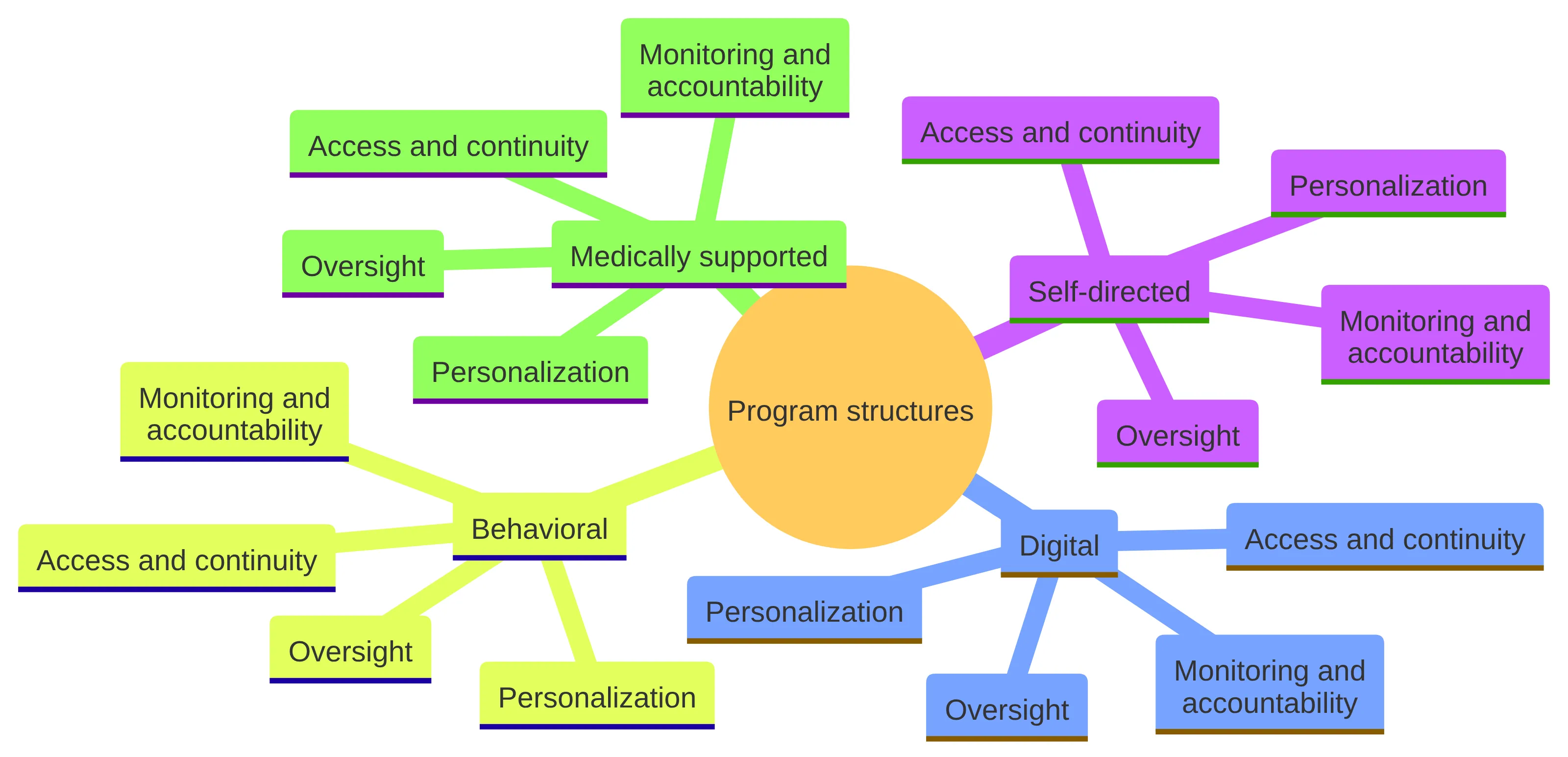
Four common program structures can be compared by support rather than by label. Self-directed, digital, behavioral, and medically supported approaches are not always separate boxes; a single program can combine them. Use the table as a question framework, then ask the provider to describe the actual services, contact pattern, monitoring, and boundaries.
| Program structure | Oversight | Personalization | Monitoring and accountability | Access and continuity |
|---|---|---|---|---|
| Self-directed | You organize the approach and decide how to respond to changes; professional oversight is not built into the label. | You choose the goals and tools, but you must decide when outside input is needed. | Tracking may be self-managed unless you add a review process. | It can fit your schedule, but continuity depends on the system you create. |
| Digital | Contact may be delivered through a website, application, messages, or remote appointments; ask who provides clinical review. | Digital tools may be tailored, but ask what is individualized beyond the technology. | Digital access may reduce travel, while the follow-up schedule and escalation process still need clarification. | |
| Behavioral | The focus may include education about behavioral factors, routines, and skills used in weight management. | Ask how goals and strategies are adapted to your circumstances. | Ask what you track, who reviews it, and how accountability works. | Ask whether support is available when work, travel, or health changes disrupt a routine. |
| Medically supported | Professional evaluation, treatment, and monitoring may be part of the structure. | Clinical information can inform a personalized plan, but the provider must explain what is assessed. | Ask what data, laboratory results, progress, or symptoms are reviewed and how plans change. | Compare appointment demands, communication, follow-up, and access to the care team. |
The comparison table is most useful when you turn each cell into a direct question. For example, do not accept “personalized” as the complete answer. Ask which information changes the plan and how you will learn about that change. Do not assume that a digital option is either fully remote or fully unsupported. Ask whether a professional reviews your information and how you can raise a concern.
Choose the structure that gives you a workable answer to the criteria that matter most in your situation. If you need regular professional review, a format without that review may not meet your needs. If work travel makes fixed visits difficult, ask whether the program has a consistent alternative for follow-up. The boundary is simple: compare the operating details, not the category name.
Test convenience against continuity
Convenience answers whether you can access care; continuity answers what happens after the first conversation. A program may fit your calendar at enrollment but become difficult to use if you cannot reach the team, do not know when follow-up occurs, or have no clear process for discussing a change. For a demanding work schedule, examine both sides before you decide.
Ask these practical questions:
- How often are follow-up conversations scheduled, and what happens if your work calendar changes?
- Who reviews your progress between visits, if anyone?
- How do you send a question or report a concern?
- What information should you bring to follow-up conversations?
- How does the program respond when the plan no longer fits your health context or routine?
The answers distinguish a convenient entry point from an ongoing care process.
Innovative Medicine describes a continuity process in which the practice reviews weight-loss progress, adjusts plans as the body changes, and provides accountability between visits. That description gives you concrete points to ask about: what progress means in the consultation, how an adjustment is decided, and what between-visit accountability looks like. It does not establish that the process is appropriate for you before an evaluation.
Digital access deserves the same careful examination. A website or application may reduce travel, but the useful question is whether the support remains clear when your circumstances change. Ask about the human review, the contact route, and the follow-up schedule before treating convenience as a reason to enroll.
Your routine should be realistic enough to repeat during ordinary weeks, not only during a quiet period at work. Consider appointment timing, travel to the office, preparation required before visits, communication between visits, and the time needed to use any tracking tool. These are not tests of motivation. They are operating conditions that can affect whether you can participate consistently.
Write down the two constraints most likely to interfere with care. Bring them into the first discussion and ask how the program handles them. A clear answer may help you eliminate an impractical format without deciding that every part of it is unsuitable.
Look beyond the promise to the operating details
Operating details show how a program would function after the initial conversation. Before enrolling, ask for a plain explanation of the evaluation, the support included, the follow-up pattern, and the conditions that would lead to a change in plan. You are not looking for a guarantee. You are looking for enough detail to compare the program with your goals, health context, and work life.
A practical question set includes:
- What does the initial evaluation cover?
- Which health concerns, prior efforts, medicines, or laboratory information should you bring?
- How are goals set and revisited?
- Which nutrition or exercise support is available?
- What treatments might be discussed, and how would the provider decide what to discuss?
- What follow-up is included, and how are plans adjusted?
- What monitoring is used, and who reviews it?
- What fees apply to the initial visit and later care?
The question about fees belongs in the first conversation because an initial-visit charge can vary by provider in Lafayette, Indiana.
Your medical history can make the evaluation conversation more specific. Prepare a concise list of relevant health conditions, current medicines, previous attempts to manage your weight, and questions about the approach. You do not need to turn that list into a self-diagnosis or a treatment plan. Its purpose is to give the professional information to consider.
Bring your goals in language that fits your life. “I want support that works with frequent travel,” “I need a clear follow-up process,” or “I want to understand what monitoring involves” gives the conversation a practical direction. A provider can then explain which parts of the program address those needs and which parts require further evaluation.
Long-term support should be discussed as a process rather than a promise. Clinical education on obesity care describes personalized strategies, education about behavioral and physiological factors, and professional collaboration to educate, treat, and monitor patients. Those findings support asking about ongoing support; they do not establish a particular outcome for you.
Ask what happens after the initial phase, how progress is reviewed, and how the program responds to a change in your circumstances. If the answer ends at enrollment, you have not yet learned enough about continuity.
Read the evidence without treating one format as the answer
Evidence about self-monitoring is mixed, so tracking should be treated as a feature to examine rather than as proof that a program will work. One review found statistically significant weight loss versus controls in 43% of studies using technology-based self-monitoring of diet, physical behaviors, or weight. The review did not make that percentage a guarantee for every program or every participant.
The practical question is what surrounds the tracking. Ask whether the information is reviewed, whether it changes the conversation, and whether you receive help interpreting a pattern. A log that you maintain alone and a record discussed with a care team may serve different purposes, even if both are called monitoring.
Digital and computer-based approaches have shown different results across studies and comparisons. One review reported a mean weight difference of −1.78 kg compared with controls for mobile-health self-monitoring interventions. The same research review reported a pooled mean weight reduction of −2.87 for web- or mobile-app digital self-monitoring interventions compared with controls. These figures describe review findings, not an expected result for your program.
The comparison, population, intervention, and follow-up period matter.
One cited trial found a difference between a computer-based intervention and an intensive in-person intervention. During the first 6 months, participants in the computer-based group regained more weight; the weighted mean difference was 2.2 kg. At 12 months, the computer-based group lost less weight than the intensive in-person group; the weighted mean difference was 4.7 kg.
That was one trial, not a universal ranking of formats. Use it to ask better questions about contact intensity, follow-up, and the kind of support you can use. Do not turn a study comparison into a personal forecast or choose a program from a number alone.
Research helps you understand what has been observed; it does not remove the need to examine how a specific program operates. When you read a result, identify the format studied, the comparison group, the outcome measured, and the time period. Then ask whether the program you are considering has the same features.
Your decision can remain practical: compare the support provided, the oversight available, the way progress is monitored, and the continuity you can realistically use. Keep evidence claims attached to their conditions, and keep your own decision attached to your health context.
Use medication questions as a safety checkpoint
Medication questions need their own checkpoint because a medicine discussion involves more than choosing a product. Guidance on weight-management medicines recommends shared decision-making around how a medicine is taken, how often it is used, how long treatment may last, what contraindications and adverse effects apply, what monitoring is needed, and whether pregnancy plans affect the decision when relevant.
You can use those topics to organize a conversation without asking the internet to choose a medicine or dose for you. Ask which options are available in the relevant care setting, what factors affect the choice, what follow-up is required, and what circumstances would change the plan. Keep the questions open until a qualified professional has considered your health information.
Medicine availability can vary by care setting, and that variation may affect which options are available. The cited guidance is from the United Kingdom, so its setting-specific examples should not be transferred automatically to Lafayette. The broader decision principle remains useful: ask where a medicine is prescribed, what monitoring accompanies it, and whether the care setting can provide the follow-up required.
Ask these questions before treating medication as the defining feature of a program:
- What evaluation is needed before medication is discussed?
- How is the administration method explained?
- How often is follow-up provided?
- Which contraindications or adverse effects need discussion?
- What monitoring is required?
- If pregnancy is possible or planned, how does that affect the conversation?
A provider should answer those questions in relation to your circumstances rather than give you a generic schedule.
A medication feature does not establish that a program is suitable for you. Do not use a comparison article to select a medicine, change a dose, or decide that a contraindication does not apply. Use the safety checkpoint to identify what you need to ask and what information to bring to a professional discussion.
Apply the comparison to Innovative Medicine without assuming fit
Innovative Medicine offers weight loss consultation appointments with weight loss experts in Lafayette, Indiana. We also offer a variety of weight loss techniques tailored to individual struggles and goals. Those facts tell you what conversation is available; they do not determine which approach, if any, fits your health context.
Use the six comparison criteria during that conversation. Ask how the evaluation addresses your goals and health concerns, what kind of personalization is possible, what monitoring is considered, how accountability works, how appointments fit your schedule, and what follow-up looks like. The answers give you something specific to compare with other formats or with a self-directed approach.
Innovative Medicine measures patient data and adjusts treatment based on laboratory results and patient improvement. We also review progress, adjust plans as the body changes, and provide accountability between visits. These are the practice’s described processes, so ask how they would apply to your consultation and what information would be relevant to your discussion.
A process that includes measurement and adjustment is not the same as a promise of a particular result. Ask what data is collected, how it is reviewed, how you are informed about changes, and what follow-up is available. Keep the distinction clear: a stated process can help you evaluate fit, but it cannot decide fit before your evaluation.
A Lafayette consultation can be useful if you want to discuss program structure before enrolling. Bring your goals, health history, current medicines, prior attempts, work constraints, and questions about nutrition or exercise support. Ask about the initial visit, fees, suggested treatments, and the follow-up process.
The purpose of the conversation is clarification. You can leave with a better understanding of what is offered, what information matters, and which questions still need an answer. You do not need to commit to a program simply because you requested information.
Prepare for an evaluation conversation
Bring a concise medical history, current medicines, previous attempts to manage your weight, and the practical limits created by your work schedule. If medication may be part of the conversation, ask what risks or contraindications should be considered. You can also ask what fees apply to the initial visit and what nutrition, exercise, or other support may be discussed.
Your work context belongs in the evaluation, not outside it. Explain whether you travel, work irregular hours, have limited appointment windows, or need a clear way to communicate between visits. These details can help you ask about continuity and access in concrete terms.
Bring the standard you plan to use after the conversation: you should understand what the program includes, who provides oversight, how progress is monitored, how plans can change, and what follow-up is available. If any of those points remain unclear, ask for an explanation before treating the program as a fit.
An evaluation is a conversation for understanding your options, not a substitute for the professional decisions that follow. Clinical care may involve personalized strategies, education about behavioral and physiological factors, and collaboration to educate, treat, and monitor patients. Ask what has been established, what still needs assessment, and what decision would come next.
Choose the next informed step in Lafayette
Choosing among weight loss programs becomes clearer when you compare the support you would actually receive: oversight, personalization, monitoring, accountability, access, and continuity. Start with your goals and health context, test the operating details, and treat research findings as context rather than as a personal forecast.
If you want to discuss those options in Lafayette, contact Innovative Medicine at (765) 471-1100. Ask about the initial visit, fees, the practice’s approach, suggested treatments, nutrition or exercise support, and follow-up. A qualified professional must determine whether a particular program or treatment is suitable for your health circumstances.
What should you ask before choosing a weight loss program?
What should I consider before choosing a weight loss program?
Before selecting a weight loss program, identify your health concerns and set clear goals. Consider how your work schedule and personal responsibilities may affect your ability to participate consistently.
What types of support can I expect from a weight loss program?
Weight loss programs may offer various types of support, including medical oversight, personalized plans, monitoring of progress, accountability measures, and access to nutrition or exercise counseling.
How can I prepare for a consultation about weight loss options?
Prepare for your consultation by organizing your medical history, current medications, previous weight management attempts, and specific questions about the program’s approach and support.
What questions should I ask during a weight loss consultation?
During your consultation, ask about the initial evaluation process, the types of support available, how progress will be monitored, and what follow-up will look like.
How does Innovative Medicine approach weight loss programs?
Innovative Medicine offers tailored weight loss techniques, including consultations with experts, personalized plans, and ongoing monitoring to adjust treatment based on patient progress.
What is the contact information for scheduling a weight loss consultation?
To schedule a weight loss consultation, contact Innovative Medicine at (765) 471-1100.
What factors can affect the choice of weight loss medications?
Factors that may influence the choice of weight loss medications include the method of administration, dosing frequency, treatment duration, contraindications, and any relevant health conditions.
Need help applying this?
Want this looked at properly?
Innovative Medicine is taking new patients in Lafayette, Indiana. Call the office and tell us what has been going on.
Call (765) 471-1100